 Main menu
A history of BBC Transcription records
Other pages in this section
A brief history and the early days of 78s

BBC transcription discs can contain any subject from:
- Top of the Pops recordings (earlier examples are good in that they can contain a different recording to the commercially released version),
- Live recordings (like the Henry Wood Promenades, now called BBC Proms),
- Comedy (like Dad's Army),
- Stories and plays (like Sixty Minutes Theatre),
- Documentories (like Magazine units),
- Quiz shows (like Just A Minute).
Apparently, the BBC stopped issuing 78s in 1947.
The oldest BBC Transcription disc I own is the record shown in this section. Based on the catalogue number, this is approximately the 6000th release (some records had two sides and some like this one didn't.) I don't know when this record was originally printed but I assume it during the years of the Second World War in the early 1940s. The subject of this particular disc is war sounds which backs the theory up. I have some other sound effects 78s as well using the same code.
The BBC had created the catalogue number format by having the disc size first 12 for 12 inch, the format or speed next - PH meaning a 78 format, then a unique number which increased by one number of each side of the disc. Although as you will see later the catalogue number changed format, this unique code was always placed in the runoff section of the record. Many labels on the disc also still showed this code. The length of a typical 78 disc was around 6 minutes per side.
Later 78 records with a new label

The disc seems to come from 1952 including hymns from BBC Hymn Book, swiftly followed by the next disc in the series with a couple more tracks from the same source.
The catalogue code for these continue the same format as the war time disc earlier, but the label has changed and both discs have been recorded on both sides. As a reminder, each side has its own code.
Catalogue number change for sound effects 78s

The contents of these discs can have many different subjects, including (in the case) aircraft noises, footsteps, clock chimes etc. These were used as sound effects for radio and later TV shows. Where the programme went out live, the sound effects were also played live. Some of these sound effects were released commercially to the public over several years starting as albums and tapes, then rereleased again as CD's later. They were only issued for non-professional users.
BBC test discs from the BBC Engineering Division 78s

Instead of music, this disc emits a specialized "Warble Tone"—a constant audio pitch that rapidly fluctuates up and down by a few Hertz.
Engineers played DOM 24 inside radio control rooms to measure acoustic reflections, room resonance, and microphone layouts. A completely steady tone creates "standing waves" in a room (making it hard to measure true volume), but a warble tone breaks up those reflections, letting engineers accurately calibrate studio playback equipment.
The BBC later released these as 10 and 7 inch discs later on.
16 inch records
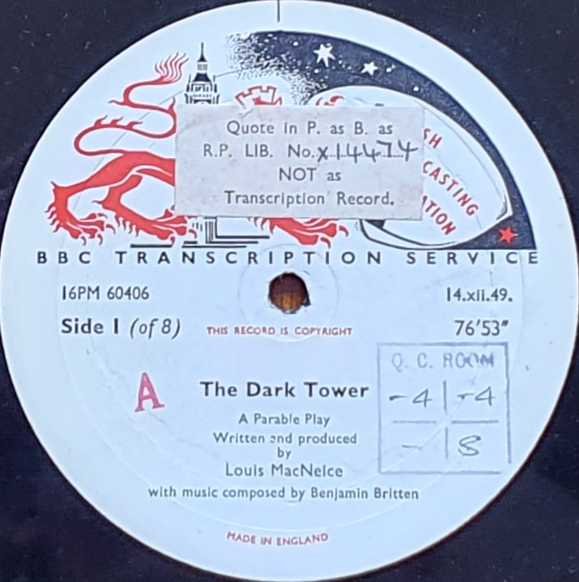
These carried a bit more space on them than the 78s above but not a lot (up to 10 minutes per side.) The big issue is that towards the centre of the disc, the noise seems to slow down. You often had the first side recorded outside to in (like records today) but the other side would be recorded inside to out so that when the next side is cued to play, the speed continues in a consistant way.
They continued to be issued until the mid-1950s.
The Dark Tower is a 1946 BBC Home Service radio play written, in verse, and produced by Louis MacNeice, with music composed for it by Benjamin Britten. Dramatist and author Robin Brooks, writing in The Guardian in 2017, called it "a landmark in radio drama".
MacNeice wrote the play in the autumn of 1945. At the time, he was still badly shaken by the wartime death of a schoolfriend, Graham Shepard, and had what might be termed survivor guilt. Britten had previously written the music for MacNeice's The Agamemnon of Aeschylus (1936), and Out of the Picture (1937). MacNeice asked Britten to write music for The Dark Tower "with the greatest economy".
10 inch records
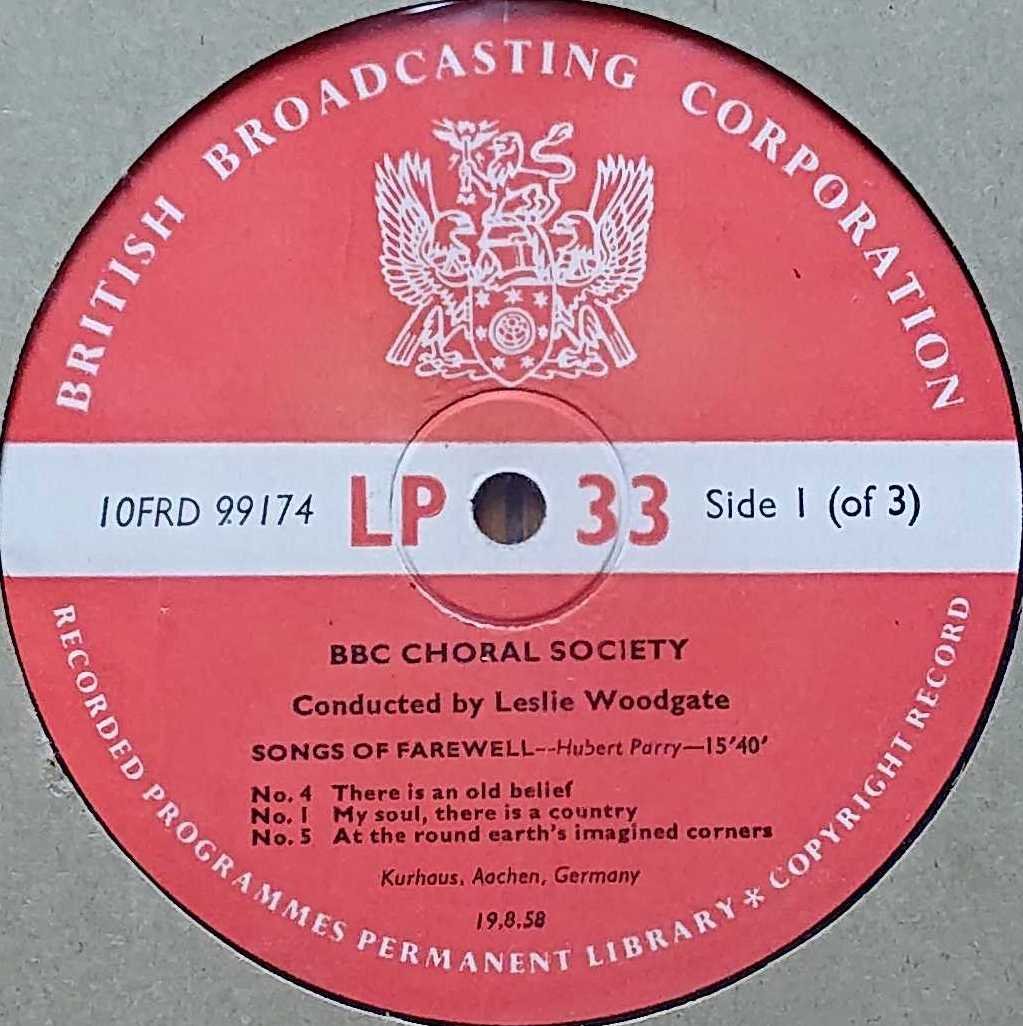
This size was replaced by the 12 inch shortly after their introduction.
Here we have another couple of records which have recorded the BBC Choral Society again, side one containing tracks written by Hubert Parry.
12 inch discs

There are several different types of transcription disc catalogues, you will find all of them contained on this site:
- BBC recorded programs permanent library (LP followed by five numbers), these were the original catalogue style which have continued on all formats.
- Standard catalogue (six figure number, different on each side), after the CN catalogue was started then these tended to be more for Top of the Pops records.
- CN catalogue (CN following by up to four numbers)
- BBC Radioplay music (SRP/TSRP prefixed catalogue, with four numbers - the first two are the year of issue + a unique number)
- BBC Radioplay music (TAIR/AIR prefixed catalogue, with five numbers - the first two are the year of issue + a unique number)
- BBC Radioplay music best of (RPLA prefixed catalogue, with a number afterwards)
- BBC Radioplay music (Gigs and Sessions - SNS prefixed catalogue, with three numbers)
Most of these used the back cover to provide details of the disc and sometimes suggested introductions. The Standard catalogue and CN catalogue usually contained paper information instead of providing that on the cover. This is because they usually contained much more information.
The 12 inch was replaced by CDs from 1988.
The example disc here is one of those albums which gives radio staions examples of the contents they are going to receive using the new format. Some are stories like Journey into Space, others are music related like the BBC Grandstand theme or BBC Jazz Club by Humphrey Lyttelton / Alan Clare / Tony Kinsey.
7 inch discs

Most of these contain trailers for the larger 12 inch disc, like the example shown here.
There doesn't seem to be many examples of this size and would have been phased out with the 12 inch size from 1988.
CDs

These discs can contain a lot more content than any of the previous incarnations - up to 80 minutes. The advantage of these discs is they are far more sturdy and even scratches on the disc are unlikely to affect play.
The BBC still issues discs in this format.
The disc shown in this section contains music and discussions from James Bond and Doctor Who and is hosted by Tony Slattery.
Copyright
© 2002-2026 Mike Everitt.This page was last updated on: 22-10-2026 16:29:32